
The Jackie Robinson Rundown
75 years ago this week, Jackie Robinson added to his legend by doing something unfathomable on the basepaths

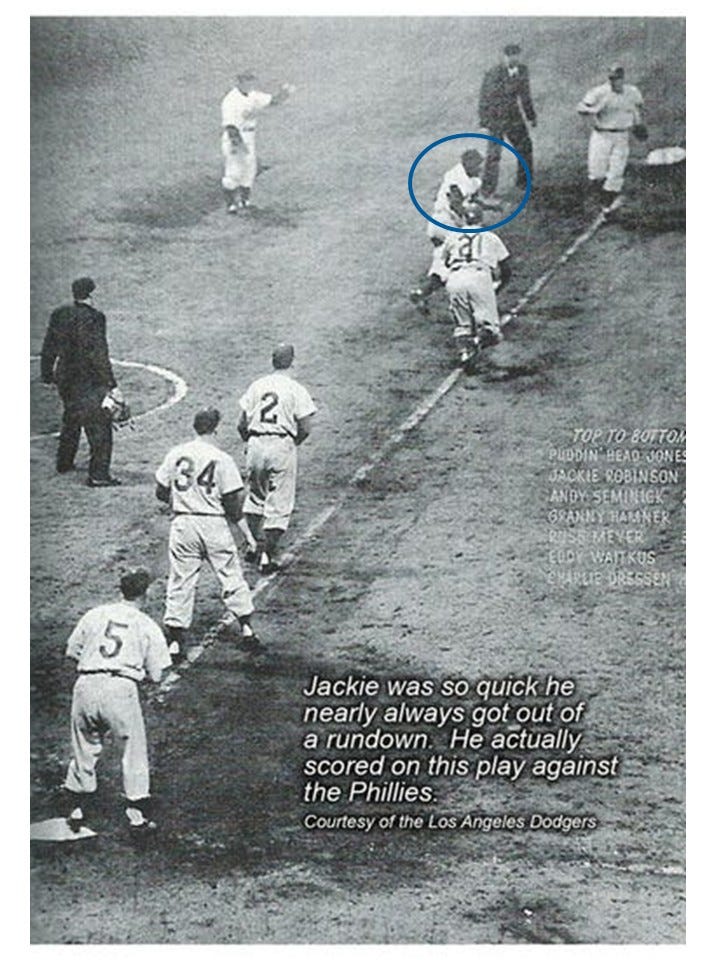
Take a look at the picture below.
The man in the blue circle is Jackie Robinson of the Brooklyn Dodgers.
Jackie is surrounded by 5 players from the opposing team.
Jackie Robinson will score on this play.
Wait, what! Jackie Robinson score on this play?
How is that even remotely possible?
In this article, you will find out what happened and the circumstances around this play.
My research on this play confirmed for me what I already thought - Jackie Robinson was perhaps the most disruptive baserunner in baseball history, and his greatness on the field is not nearly celebrated enough.
BACKGROUND
Last year, a subscriber to The Sports Time Traveler shared a book with me. The book was titled, “What I Learned From Jackie Robinson,” and was written by Carl Erskine, who like Jackie, was one of the Boys of Summer. Carl was a mainstay in the Brooklyn Dodgers’ pitching rotation in the 1950s.
It was a sensational book, filled with all sorts of anecdotes about Jackie Robinson and Carl Erskine’s other band of brothers as they contended for the National League pennant in every year of Jackie’s career from 1947 to 1956, and won a World Series title in 1955.
You can find Carl Erksine’s book on Amazon at this link:
What I Learned From Jackie Robinson - by Carl Erskine
There was one picture in the book that had me completely enthralled. When I first came across it, I just stared at it for a while, trying to get my head wrapped around the caption.
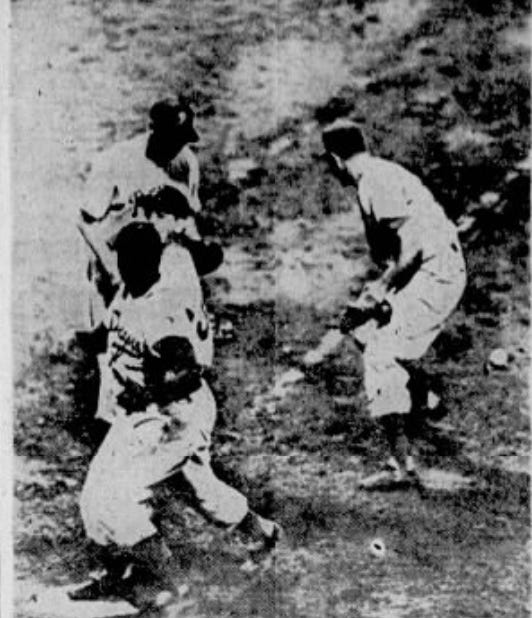
It’s the picture up above, in which Jackie Robinson caught in a hopeless rundown between 3rd base and home, surrounded by 5 players.
Looking at the picture, it seems like an impossible mission for Jackie. No one could get out of this jam. Yet, the caption at the bottom reads, “Jackie was so quick he nearly always got out of a rundown. He actually scored on this play against the Phillies.”
You can’t believe everything you read. Just because the picture was in the Carl Erskine book, I had to investigate this to verify it was real.
As The Sports Time Traveler, this is just the type of journey I love. I had to go back in time, virtually, to find this game and determine what happened.
Finding the game was not easy. Luckily, I had a few clues. The other caption in the picture listed the names of the players. Using that as a start, I determined this game took place on May 31, 1951 in Ebbets Field between the defending National League champion Phillies and the Dodgers.
In the writing style that I’ve adopted for The Sports Time Traveler, the datelines on my stories are when I read about the games in the newspapers, and so this story is dated June 1, 1951, or 75 years ago this week.
Now join me back in time for the story of my trip to experience “The Jackie Robinson Rundown.”
EBBETS FIELD - June 1, 1951
Last night I was in Ebbets Field in Brooklyn (virtually) to find out exactly what happened in the picture I had seen in the Carl Erskine book. It’s a picture I’m calling, “The Jackie Robinson Rundown.”
The Dodgers were hosting the defending National League champion Philadelphia Phillies. The Phillies had won the 1950 pennant on the final day of the season over the Dodgers. It was another heartbreak for ‘dem Bums who’d previously lost the 1941, 1947 and 1949 World Series to the Yankees.
In the bottom of the 8th inning, the Dodgers lead 3 - 2. With 1 out, Jackie Robinson came to the plate. He hit a grounder to the Phillies’ shortstop, Granny Hamner, and he beat it out for an infield single.
Hamner is one of the best defensive shortstops in baseball. But Jackie Robinson beat out the throw to 1st base.
Robinson Safe at 1st
The infield hit raised Jackie’s batting average to a major league leading .407, and nearly 30 points higher than anyone else.
With Jackie on 1st base and 1 out, Gil Hodges stepped up to the plate. Hodges has driven in 34 runs in just 39 games this season, putting him 3rd in the major leagues in that department behind Ted Williams and Hodges’ teammate Duke Snider.
But Jackie Robinson didn’t wait for Hodges to get a long hit that could drive him in. With the Dodgers in need of an insurance run in this tight game, Jackie took off for 2nd base. He was safe, and now in scoring position if Hodges could just drill a single.
Robinson Safe at 2nd
On the mound was Russ Meyer. He had been a 17 game winner for the Phillies in 1949, but had an off year during the Phillies’ pennant season last year in 1950. Here in 1951, however, Meyer was back in his 1949 form. He came into the game with a 2.83 ERA in his first 6 starts, which included a shutout. He also came into the game having only hit 6 batters in his career to date in over 100 games pitched.
But Meyer hit Gil Hodges.
Now with Robinson on 2nd, and Hodges on 1st, and 1 out, right fielder Carl Furillo stepped up to the plate. Furillo already had 26 RBIs on the season, even though he was off to a slow start batting under .260. And in this game, Russ Meyer had already retired “The Reading Rifle” (as he was called because of his explosive right arm in the outfield) 4 times, including 2 by swinging strikeouts.
Meyer was also having control problems in this contest, having already walked 8 Dodgers. And Meyer may have been on edge with Jackie having just stolen 2nd base. Jackie was always a threat on the basepaths, and he had scored the 4th most runs in the majors over the past 4 seasons.
Meyer threw a pitch that bounded before the plate, according to Dick Young in the Daily News. Andy Seminick, the catcher, smothered the ball, which did not get past him. But that moment was all Jackie Robinson needed. Robinson dashed for 3rd base. Seminick threw to Puddin’ Head Jones covering the bag. Jackie made it into 3rd safely.
Robinson safe at 3rd!
On the play, Gil Hodges moved up to 2nd.
Now with runners on 2nd and 3rd and still just 1 out, Dodgers’ manager Chuck Dressen, possibly sensing that “Skoonj” (Furillo’s other affectionate nickname) was having a tough game against Meyer, called for a suicide squeeze bunt in which Jackie would dash for home while Furillo would bunt.
However, it was truly an off game for Furillo. He missed the bunt attempt.
Jackie Robinson, who was gunning for home on the daring squeeze play, was now caught off 3rd base.
The Rundown Begins
A prolonged rundown ensued. Phillies’ catcher Andy Seminick initially threw back and forth to 3rd baseman Willie “Puddin’ Head” Jones, according to Stan Baumgartner in the Philadelphia Inquirer.
The Brooklyn Eagle reported that in the drill that ensued, Seminick, Puddin’ Head Jones and Granny Hamner all handled the ball.
In addition, pitcher Russ Meyer and 1st baseman Jimmy Bloodworth lined up near home plate.
In the picture below, you see the following players from top to bottom:
Puddin’ Head Jones is closest to 3rd base, just next to the umpire
Jackie Robinson is in the blue circle. He is the only Brooklyn Dodgers players in the picture.
Andy Seminick, #21, is just below Robinson.
Granny Hamner, #2, is the first of 3 Phillies guarding the path to home plate
Russ Meyer, #34, is behind Hamner
Jimmy Bloodworth, #5, is standing with his foot on home plate.
Note that the picture caption indicates Eddy Waitkus is in the rundown, but Waitkus, the regular 1st baseman for the Phillies, did not play in the game. Bloodworth played for Waitkus at 1st.
The caption also indicates that Chuck Dressen is at the bottom of the picture, but Dressen is actually the man coaching at 3rd base. Dressen, the Dodgers’ manager, frequently coached at 3rd base during games.
What a sight! Five Phillies are chasing down 1 Dodger. But this Dodger, Jackie Robinson, was the ultimate dodger, one of the best, if not the very best ever at dodging a tag on the basepaths.
Joseph Sheehan in the New York Times reported the beginning of the play this way:
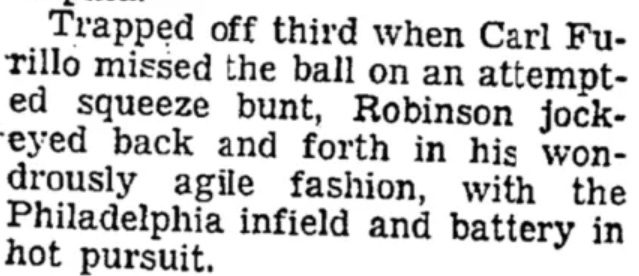
Dick Young in the Daily News wrote, “Jackie, however, was his old masterful self on the base lines. He jockeyed back and forth while Seminick and Jones, and Hamner flipped the ball over Jackie’s head five times. Jackie worked closer to the plate with each toss.”
Jackie’s Dash
Suddenly, while Jones was holding the ball, Jackie Robinson made a bold move.
Baumgartner reported, “Robinson broke past Seminick.”
Sheehan described it with more flair:
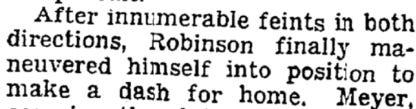
Puddin’ Head Jones then whipped the ball down to Russ Meyer, who was near home.
Harold C. Burr of the Brooklyn Eagle wrote that, “Meyer muffed the ball,” meaning he dropped it.
But the New York Daily News play-by-play of the game indicated that Meyer didn’t drop the ball when it was thrown to him, rather the ball popped out of his glove as he tried to tag Robinson:

Joseph Sheehan in the Times had a slightly different account:
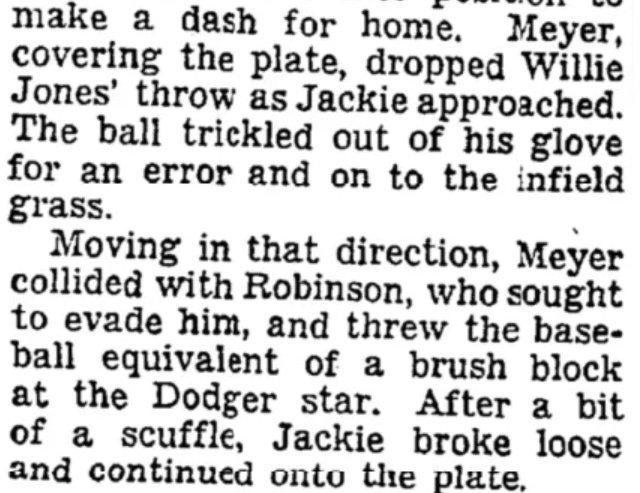
The Play Gets Dirty
Russ Meyer either attempted to retrieve the ball and accidentally smashed into Jackie Robinson, or he intentionally tried to block Robinson from reaching home, or both.
Sheehan wrote that Meyer, “threw the baseball equivalent of a brush block at the Dodger star.”
But Dick Young, who wrote the full story of the game for the New York Daily News described it differently, “With the ball lying on the ground, Robinson rammed into Meyer like a guy trying to force his way into a subway car while another fellow is coming out.”
Either way, Meyer was not able to get to the ball. And, of course, Jackie Robinson, being a fierce competitor, was intent on reaching home plate for a much needed Dodgers’ insurance run.
Baumgartner in the Philadelphia Inquirer wrote, “Robinson pushed Meyer.”
The New York Daily News emphasized that Robinson, “pushed Meyer several times in order to get to the plate.”
Jackie Robinson was not going to be denied. He touched home plate and scored the insurance run the Dodgers needed to make the score 4 - 2 Dodgers in the bottom of the 8th.
Jackie Scores!
An AP photo ran in only a few newspapers that were outside of New York and Philadelphia. I found it in the News Tribune on the other side of the country in Tacoma, WA.
The picture below shows Jackie Robinson touching the plate as he is turned back towards Russ Meyer. The other Phillies’ players in the picture were listed in the caption as Jimmy Bloodworth (top left) and Willie “Puddin’ Head” Jones (top right), but again the caption is wrong. Granny Hamner, who had been positioned closer to home than Jones the 3rd baseman was wearing an under shirt that extended beyond his uniform sleeves. Puddin’ Head was not. You can see that in the earlier picture of the rundown. Granny Hamner, not Puddin’ Head Jones, is the player on the right side of the picture staring down at the dropped baseball.
The Mission Impossible Was Completed
Jackie Robinson had done the impossible. He had scored despite being caught in a rundown against 5 Phillies’ players.
Jackie Robinson was already 32 at this time, yet he still possessed world class quickness. It’s not that surprising, given that his older brother, Mack Robinson had pure world class speed. Mack Robinson won the silver medal in the 200 meter dash at the 1936 Olympics, finishing in 2nd place to Jesse Owens.
NOTE From The Sports Time Traveler
The story of Jackie Robinson’s brother Mack Robinson is not well known. As a result, it’s one I will be researching and writing about next month when we reach the 90th anniversary of the 1936 Olympics.
Now back to 1951.
Jackie Robinson - Perhaps the Most Disruptive Baserunner
If Jackie Robinson could have played in the major leagues prior to age 28, which is when his color barrier breaking 1947 season took place, he could have provided fans with many more of these special moments.
Jimmy Powers, the famous sports columnist in the New York Daily News, was so moved by Robinson’s feat that he wrote on this day, “If Jackie Robinson had entered the pro game in his teens, he would have become one of the truly great second basemen of all time.”
But in the moment, last night, there was no opportunity to celebrate the breathtaking play.
Mayhem Was Getting Started
As soon as Robinson scored, Russ Meyer took exception to being pushed, and he “charged after Jackie,” according to Baumgartner.
Baumgartner wrote, “They stood chest-to-chest for about 15 seconds.”
The Daily News indicated Meyer was, “shouting at Jackie.”
All the players from each team came out onto the field.
Roy Campanella of the Dodgers restrained Jackie, while Jimmy Bloodworth did the same to Meyer.
For a few moments, all seemed fine. The game was set to proceed with Jim Konstanty relieving Russ Meyer.
But Meyer, instead of going to the clubhouse, remained on the Phillies’ bench and more heated words were exchanged.
A Brawl in Brooklyn
The New York Daily News wrote that Meyer, “gestured to Robinson to meet him under the stands.
Burr in the Brooklyn Eagle wrote that Meyer, “challenged Robinson to fight it out with him under the stands and Robinson immediately disappeared down the Dodger steps.”
Baumgartner in the Philadelphia Inquirer pinned the blame for the near brawl on Jackie, “A moment later, Robinson, incensed by the challenging remark made by Meyer as he moved off the field, left the bench and went down the runway apparently to intercept Meyer beneath the stands.”
The New York Daily News described what happened next, “Within a moment, players on both sides were rushing down their respective stairways. Many fans left their seats and rushed under the stands for a promised free for all.”
There was a chance that chaos and an out-of-control brawl could ensue.
Baumgartner wrote, “For a minute or two the excitement was intense, and thousands waited - not knowing what was going on beneath the stands.”
But the umpires were miraculously able to restore order in quick fashion. The Daily News reported that, “The umpires also ran off the field and succeeded in restoring order, and play was resumed.”
Dick Young had the scoop on how the umpires did it as he wrote, “Umpire Larry Goetz shouted to Robinson, ‘Get back up here and play.’ Robinson heeded Goetz. By the time Meyer reached the spot in the passageway that contacts the Dodgers dugout, Jackie was back on the playing field.”
So the two combatants never actually faced off underneath the stands.
Playing Baseball; Not Basebrawl
With the game back underway, Carl Furillo struck out swinging for the 3rd time in the game. And Roy Campanella popped up to the catcher to end the hard-fought inning.
With the Dodgers ahead 4 - 2, Carl Erskine came out to pitch the top of the 9th. Erskine had entered the game in relief in the 3rd inning, and had pitched marvelously allowing just 1 hit and 1 walk in 5 and a 1/3 innings. Erskine was in line to pick up his 4th win of the young season. Not only had Carl pitched nearly perfect ball according to Burr in the Brooklyn Eagle, but he’d also contributed with a double and two perfect bunts. Erskine was 3 for 3 at the plate.
Carl Erskine Tries to Close Out the Game
But now Carl had some tense moments. He gave up a lead off single to Seminick. And then 2nd baseman Mike Goliat hit an “unplayable trickler down the third base line,” according to Dick Young.
Now the tying run was on base and Bill Nicholson came up as a pinch hitter for the pitcher. Nicholson was nearing the end of his career, but he was still a dangerous sight at the plate. He had led the NL in home runs twice during the war years.
Jackie to the Rescue Again!
Erskine got Nicholson to hit a fly over Jackie Robinson’s head at 2nd base. Dick Young reported, “Robinson made a fine twisting grab.”
In the Philadelphia Inquirer, Baumgartner wrote that Jackie, “made a fine running catch. It was a game saver.”
That gave Erskine 1 out, but there were still 2 men on base.
Next up was Richie Ashburn. He came into the game batting .339, and he slashed a single through the middle to drive in a run and make the game 4 - 3 Dodgers.
Now with 1 out and men on 1st and 2nd, Erskine was in a tough situation with Granny Hamner coming up. Erskine got Hamner to hit a hard roller to Pee Wee Reese at shortstop. He flipped to Jackie Robinson at 2nd base for the force out, and Robinson threw to Gil Hodges at 1st base for a game-ending double play.
After 3 hours and 14 minutes, exceptionally long for games here in 1956, the contest was over. The Dodgers had won it 4 - 3. The Jackie Robinson Rundown had provided what turned out to be not just an insurance run, but the winning run in the game.
The Dodgers are in 1st place with a record of 24 - 15. The defending NL champion Phillies are now 8 games back.
Apologies After the Game
A United Press article, that appeared in the Staten Island Advance, reported that, “About an hour after the game, Meyer went into the Dodger dressing room and apologized. Both players then posed shaking hands.”
I was unable to find that picture in any newspaper.
Joseph Sheehan in the New York Times provided more details, “The Philadelphia pitcher, noted for his fiery temper, was under the mistaken impression that Jackie had veered from the baseline to jar the ball from his hands.”
Baumgartner in the Philadelphia Inquirer added another note, “Jackie shook hands with Meyer and not only accepted the apology but eased Russ’ feelings by assuming part of the blame. ‘It was as much my fault as his,’ said Robinson. ‘If I didn’t start down there to meet him there would have been no trouble.’”
FINAL NOTES From The Sports Time Traveler
Two years later, in 1953, Russ Meyer was traded to the Dodgers.
It has been reported that when Meyer first met Robinson during spring training in Dodgertown at Vero Beach that year, Jackie walked up to him and shook his hand and said, “We’ve been fighting one another. Now let’s fight them together.”
Together, Meyer and Robinson, and the other Boys of Summer, finally won a World Series Championship in 1955.
I would have never come across this incredible play, The Jackie Robinson Rundown, if I had not read Carl Erskine’s book about Jackie last year.
Near the end of the book, Carl wrote, “I believe Jackie single-handedly kicked off the civil rights movement, but it would have been nice if someone phrased it that way.”
In my recently published book, THE 1955 BROOKLYN DODGERS - MY DAD’S TEAM, I took heed of Carl’s statement about Jackie, and included that quote by Carl in my book.
As a result of researching and writing, THE 1955 BROOKLYN DODGERS - MY DAD’S TEAM, I have a great affinity for Carl Erskine, Jackie Robinson and all the other Boys of Summer.
The book makes for a great Father’s Day gift.
Here is a link that takes you directly to the listing for the book on Amazon:
Amazon Listing
If you’d like a personalized edition of the book with a custom inscription on the opening page, I have a limited number of books available on Etsy. The personalized edition makes for a sensational Father’s Day gift: