
The 1966 U.S. Open at Olympic - FINAL ROUND

OLYMPIC CLUB - SAN FRANCISCO, June 21, 1966
After 3 rounds, only 3 men had a reasonable chance to win the U.S. Open.
Arnold Palmer held a 3 shot lead over Billy Casper. This pair, pictured below with Casper on the left and Palmer on the right, played head-to-head in the final group. One hole ahead of them, and 1 shot ahead behind Casper in 3rd place, was Jack Nicklaus.
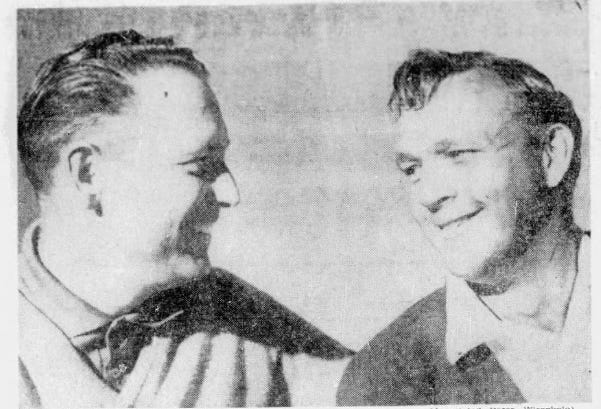
Everyone else was at least 6 shots behind Palmer, and did not have the pedigree of these three greatest American golfers of this time. Only these 3 men remained in contention.
While the Big 3 of golf worldwide are Arnold Palmer, Jack Nicklaus and Gary Player. The giants of the PGA TOUR at this time are Palmer, Nicklaus and Billy Casper.
The Giants of the PGA
Arnold Palmer is already, at age 36, the #1 all-time PGA money leader and has won 47 events, the 4th most in history.
Jack Nicklaus, at just 26, is already #5 all-time in career money, and has won 18 times on tour.
And Billy Casper, turning 35 in a few days, is #2 all-time on the money list and has won 29 times, making him the 11th winningest player in PGA events.
And here they were in a battle for the most important golf tournament in the world in 1966.
NOTE From The Sports Time Traveler
By the end of the year, this trio will be the #1, #2 and #3 all-time money winners in PGA history.
Now back to 1966.
The King Begins the Round with a Bang!
The King, Arnold Palmer, opened the final round in spectacular fashion, sending Arnie’s Army into a tizzy. Palmer blasted a driver from the deck on his 2nd shot from the 1st fairway that landed 20 feet from the pin on the 536 yard par 5 hole. He 2-putted for an opening birdie, immediately extending his lead to 4 strokes.
Lincoln A. Werden wrote in the New York Times about how Arnie’s signature performance on 1st hole had his army charged up:
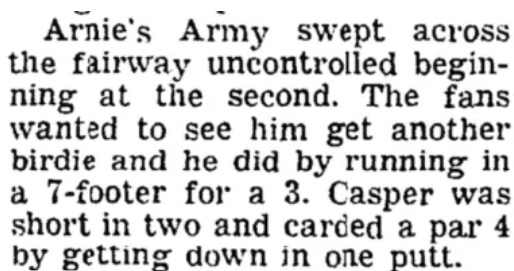
After 2 holes, Palmer had a 5 shot lead.
And when Billy Casper bogeyed the 3rd hole, Arnold Palmer’s lead increased to 6 strokes.
Werden wrote that Palmer, “had the crowd constantly cheering” on the front 9.
It got even better for Palmer. He made a 15 foot birdie putt at 7. And when he rolled in a 30 footer for another bird on the 9th, it capped off a stunning 32 on the front 9 to Casper’s and Nicklaus’s 36’s.
The Back Nine
As we go to the back 9, I’d like to enable you to have the same experience I had watching the final holes of the 1966 U.S. Open on my virtual journey back in time.
At this link, you can view the ABC-TV coverage that kicked off when Palmer and Casper made the turn.
ABC TV Coverage of the Final Round of 1966 U.S. Open at the Olympic Club
The ABC announcers are Jim McKay, Chris Schenkel, Bill Fleming and the great Byron Nelson. It’s an all-star cast of announcers, and it’s wonderful to listen to them.
I provide timestamps below for the highlights from the video:
0:00 - As ABC comes on the air, the first thing they show you is Ben Hogan on the 18th hole standing over a 20 foot putt for a final round score of 69. Hogan comes up just short and taps in for a 70 and a total score of +11. At that point, Hogan was tied for the 2nd best round of the day, and it put Ben in position to possibly qualify for the 1967 U.S. Open next year, as the top 15 are automatic qualifiers. Hogan received a standing ovation as he finished.
3:35 - We see the leaderboard on TV for the first time:
-6 Palmer (through 9 holes)
+1 Casper (through 9 holes)
+3 Lema (through 11 holes)
+3 Nicklaus (through 10 holes)
+6 Rodgers (through 11 holes)
With 9 holes to go, Arnold Palmer leads Billy Casper by 7, he has a 9 shot cushion over Jack Nicklaus and Tony Lema.
At this point, everyone agreed the tournament was over. The best player in the world with a 7 shot lead and 9 holes to go is golden.
Art Rosenbaum, writing in the San Francisco, made note that at this moment in the round, the London newspapers started filing their stories, hotel operators began renting out the players’ rooms, and the PGA typed out “a full biography of the winner” (although to their credit it was with the caveat - if Palmer wins):
A Record for Arnie?
With the tournament effectively over, the big question now is whether or not Arnold Palmer can break Ben Hogan’s U.S. Open scoring record of 276. At this moment, Palmer simply needs to shoot a 37 (+2) on the back 9 to beat the record on this par 70 course.
Unfortunately, on ABC we can’t yet see Arnold because ABC only has cameras set up on the 14th to 18th holes.
If we could see, we would have watched Arnie hit a poor drive on 10 and make bogey. This left him 6 strokes ahead with 8 holes to play.
20:50 - Most golf fans watching ABC get their first ever glimpse of Johnny Miller as he tees off at the 17th hole. 19-year=old Miller, who just completed his sophomore year at Brigham Young University has played a remarkable tournament. He is presently at +8, just 2 shots out of 5th place.
25:10 - We see the leaderboard again. After dropping a shot with a bogey on 10, Palmer gained it back with a birdie on 12. Casper also birdied the 12th, to stay 6 shots back, but now with just 6 holes to go.
-6 Arnold Palmer
EVEN Billy Casper
+4 Tony Lema
+5 Jack Nicklaus
+6 Phil Rodgers
27:45 - Johnny Miller hits his 2nd shot on 17. He’s hitting a wood into a 443 yard par 4, and he comes up a little short. And he’s a long hitter, even at 19. My gosh, how the game is different back here in 1966.
29:40 - Miller is chipping to the 17th green and lands the ball 20 feet short of the pin. Byron Nelson says that Miller’s overall play in this year’s U.S. Open is the, “finest showing by an amateur since Jack Nicklaus.”
30:30 - Even more fascinating than seeing young Johnny Miller is the description of the “Continuous Putting Rule” that has been implemented by the USGA for the U.S. Open here in 1966. At this point on the tape, Byron Nelson explains the rule.
Very simply, once a player starts to putt on the green, he must continue to putt until he holes out. And he’s not allowed to mark the ball again. This rule has dramatically sped up play in this year’s U.S. Open, and many of the top players, including Jack Nicklaus, have praised the new rule.
NOTE From The Sports Time Traveler
Although there were demonstrated advantages of dramatically faster play during the 1966 U.S. Open, the rule was ultimately rescinded in 1970 due to an array of problems with the rule, such as inability to clean a ball, stepping in the line of another player and added stress on the players.
The rule has never been reconsidered.
Now back again to 1966.
33:00 - ABC gives us another check on the leaderboard:
-5 Arnold Palmer (through 13)
EVEN Billy Casper (through 13)
+4 Tony Lema (through 15)
+4 Jack Nicklaus (through 13)
+6 Phil Rodgers (through 15)
Palmer bogeyed the 13th and his lead is now 5 shots over Casper.
35:00 - Half an hour into the broadcast we get our first glimpse of Jack Nicklaus. Watch him tee off at the par 3 15th hole. It’s a beautiful setting with Lake Merced behind the tee box.
36:25 - And now, at last, we see the final group. Watch Casper on the 14th fairway. And hear Jim McKay describe Casper’s “Great shot,” as it lands inside 10 feet.
Stay with the video to see The King for the first time on TV during the final round. As Palmer is standing in the middle of the fairway surveying the shot to come, Jim McKay describes how Palmer has been playing, “Palmer has been driving tremendously today, I saw him on the first hole when they started. He drove 270 yards, and to the cheers, the almost animal-like cheers of Arnie’s Army, he pulled out a driver for his second shot and blasted it onto the green.”
During McKay’s reminiscence of Palmer’s opening hole birdie, Arnie decides to change clubs.
As Palmer takes his time preparing to swing, McKay tells the audience, “If he pars in he will break Hogan’s record by one shot. So it’s Palmer against the record right now.”
As McKay finishes that thought, Palmer strikes the ball, and as it lands on the green, long and a little left, it’s clear that Arnie picked a club too much. He will have at least 40 feet for birdie.
41:15 - Palmer stands motionless over his 40 footer on 14 for nearly 20 seconds before stroking the putt. The crowd noise rises as the ball appears to have a chance to go in. It rims the cup on the right side, circles the back of the rim, and darts away left, as the crowd noise changes from rising “Oh’s” to deflating “Aw’s.”
With a tap in par for Palmer, McKay reminds the audience that he remains one shot ahead of Ben Hogan’s record score from 1948.
Stay with the tape to see Casper’s birdie putt.
Before Casper putts, McKay says, “Bill Casper has this for a bird, he could move within four shots of the lead, and stranger things have happened in the United States Open so stay with us.”
Casper misses the putt short.
The final pair now move to the 15th tee. Arnold Palmer holds a 5 shot lead with 4 holes remaining.
43:50 - On the 15th tee we see a classic shot of Palmer hitching his pants up both before and after as he grabs a club. McKay says, “He knows only one way to play golf, and that is to charge.” As Palmer prepares to swing, McKay describes Arnie’s Army, “An undisciplined army, more like a band of revolutionaries really. They shout and holler and scream and run. But now they’re silent because their leader is about to hit a 7 iron into the 15th green.”
Palmer goes directly for the flag, which is guarded by a bunker. His shot doesn’t make it over the bunker, and he’s in the sand. He has a good lie, but as McKay describes, it will be a difficult shot, as there is a very sharp bank and then the green runs down to the pin.
46:52 - Palmer hits a sensational shot out of the bunker. The ball rolls by the pin and stops 10 feet past. McKay indicated it was almost impossible to stop it any shorter.
48:00 - From 30 feet, Casper strokes his birdie putt. It goes right into the center of the cup. A brilliant 2 on the par 3. And now Casper has put Palmer under substantial pressure. Palmer still has a 10 footer for par to avoid a 2-stroke swing.
49:10 - Arnie stands over his par putt for 20 seconds before stroking the ball. He gives it a strong run, and it slides past the hole on the left.
Arnie bogeys and his lead is cut to 3 shots with 3 holes remaining.
The leaders now move on to the 604 yard par 5 16th hole.
51:48 - After Billy Casper’s drive lands safely on the right side of the fairway, Palmer has his ball already teed up by the time the camera pans back. But Arnie belts a vicious duck hook that hits a tree and bounces back into the left rough.
The Muffed Shot
53:45 - Watch as Palmer hits an iron out of the thick rough and back into the fairway. But what the announcers don’t know, and what ABC has missed entirely in their broadcast, is that this is Arnie’s second shot from almost the exact same spot. Moments earlier, with no ABC camera on him, Arnold Palmer “muffed” a shot from the rough that rolled about 8 feet. And thus Palmer, is now in the 16th fairway lying 3.
Hogan’s Spot
Meanwhile, as Billy Casper hits his 2nd shot from the fairway, ABC’s Bill Fleming tells the audience that Ben Hogan is now in 14th place and “nothing can dislodge him from that spot.” Ben Hogan has qualified to compete next year in the 1967 U.S. Open at age 54.
Advantage Casper
Casper’s 3rd shot lands safely in the right side of the fairway. He now has a stroke advantage on this hole due to Palmer’s “muff.” Casper is lying 2, while Palmer is lying 3 and from farther back.
57:20 - Palmer readies to hit his 4th shot. But ABC still doesn’t know this is his 4th shot. Bill Fleming tells the TV audience that Palmer is getting ready to hit his 3rd shot. Palmer is still far enough away from the green that he requires a wood for this shot. His shot lands in the trap to the right of the green.
Arnold Palmer has now taken 4 shots on this hole, and is still not on the green.
59:10 - Casper hits his approach shot. It’s a beauty, landing to the right of the hole and rolling towards the pin. It stops 12 - 14 feet away. He will have a birdie putt. While Palmer will be hitting for par out of the sand.
1:00:30 - Palmer hits from the trap. It’s a brilliant shot that stops 3 feet from the hole.
1:01:45 - Casper rolls in his birdie putt, his second in a row. And now Bill Fleming finally tells the TV audience about Palmer’s mishit in the rough on his 2nd shot, “The word on Arnold Palmer is that he muffed a shot in the rough, which we did not see, and he does lie 5. This is putting for a 6.”
Palmer now readies to putt for bogey.
Quite remarkably, Palmer needs to make the putt to retain a 1 shot lead.
1:02:48 - Palmer rolls the ball in, and after he picks it up out of the cup, he breathes a sigh of relief that is captured on the TV camera.
The Greatest Six
After the round, Palmer told Ted Blofsky of the Chico Enterprise Record, “It was the greatest six I’ve ever made.”
Now, the leaders headed to the 17th hole with Palmer ahead of Casper by just a single shot.
1:03:57 - Here’s a sight we never see in U.S. Open play in the present time. Watch as Arnie is lighting up a cigarette on the 17th tee, as we also see the leaderboard on the screen again:
-3 Arnold Palmer (through 16)
-2 Billy Casper (through 16)
+5 Jack Nicklaus (through 16)
+6 Tony Lema (finished)
+6 Phil Rodgers (through 18)
1:05:00 - After Casper has hit into the right rough, Palmer hits another hard hook into the left rough that scatters the crowd.
1:07:37 - Palmer addresses the ball. Byron Nelson says that it’s so deep down you can’t see the ball. Palmer hits the ball across the fairway into the right rough and 40 yards short of the green on this par 4.
1:08:43 - Casper has an excellent lie on the trampled grass in the right rough. He hits his shot short of the green and left.
1:10:40 - Palmer’s 3rd shot lands 10 feet from the hole. The crowd roars. Palmer will have a makeable putt for par.
1:11:50 - Casper has a tough shot. He has to pitch over a trap. He hits it perfect and it stops 3 feet from the cup.
1:13:13 - Palmer putts for par. If he makes it he will head to the final hole with at least a 1 shot lead. The uphill putt is on a perfect line, but it stops just short. And Palmer has bogeyed his 3rd consecutive hole.
1:14:10 - Casper rolls in his par.
The Championship is Tied
1:16:00 - ABC missed Casper’s tee shot on 18. He hits into the right fairway.
As Arnie gets ready to hit his drive on 18, Byron Nelson says, “A few holes ago, everyone thought that this championship was over. Golf is the strangest game in the world.”
Palmer then drives into the left rough.
1:18:20 - Palmer hits out of the rough, and the ball lands on the green, hole high, but rolls 30 feet past the pin.
1:19:10 - Casper hits his shot inside of Arnie’s and on the same line.
The ABC broadcast cuts off the final round here.
From the newspaper reports, on the 18th green, Palmer’s first putt ended 4 feet from the hole. With the continuous putting rule, he had to putt out, and he made the 4 footer to finish at -2 for the tournament.
Then Casper 2-putted and the pair finished tied.
It was an outcome no one anticipated an 2 hours earlier or even less than an hour earlier. There would be an 18 hole playoff the following day.
The Playoff
Palmer and Casper played very fast during the Monday playoff and they were already on the 16th hole by the time ABC came on the air.
The day had gone similar to Sunday. Palmer went out in 33 and built a 2 stroke lead after 9 holes. But on 10, Palmer took bogey, while Casper made birdie and the match was tied.
On 13, Casper made birdie to move ahead by 1 shot. And when Arnie bogeyed 14, Casper went in front by 2.
On 15, it was yet another bogey for Palmer and Casper was up by 3 with 3 holes to go.
1:21:40 - Palmer tees off on the long par 5 hole number 16. This was the hole on which Palmer completely unraveled on Sunday. He hits a tree on the right and the ball drops down into the gallery.
1:24:28 - Palmer hits his 2nd shot out of the heavy rough. And just like yesterday, Palmer can’t get off a shot. His balls rolls about 30 yards.
1:25:35 - Palmer is still 300 yards from the green when he hits his 3rd shot. It stops in the fairway 60 yards short of the green.
1:28:45 - Billy Casper is on the green in 3 and has a birdie putt. Palmer now is pitching from 60 yards. He must get it close to the pin. But he leaves it short, and it’s in the bunker.
1:29:28 - Palmer is in the bunker hitting his 5th shot. He lands it 6 feet from the pin. But he is now putting for bogey, while Casper is putting for birdie.
1:30:40 - Billy Casper’s birdie putt goes about 5 feet past the hole. Even though he’s inside the distance of Palmer’s ball to the cup, Casper must putt out and is not allowed to mark his ball. This is a great example of the new continuous putting rule.
The added pressure of the continuous putting rule may contribute as Casper misses the putt and bogeys the hole.
But Palmer misses his bogey putt. He shakes his head knowing that he’s hopelessly behind. Casper now leads by 4 shots with 2 holes to go.
On 17, Palmer makes par while Casper bogeys, but Palmer is still 3 shots down going into the final hole.
1:45:45 - Casper hits his approach shot on 18 from 100 yards to 3 feet from the hole. In doing so, it ends any final hopes among Arnie’s Army’s for a miracle finish. Casper makes the birdie putt to win by 4 shots.
Arnold Palmer went out in 33 and came home in 40, while Billy Casper shot 35 - 34 for a 69 and the U.S. Open Championship.
For the 3rd time in 4 years, Arnold Palmer has lost the U.S. Open in an 18 hole playoff.
The Sunday Collapse and The Greatest Comeback
After the tournament, the focus remains on Palmer’s Sunday collapse and the steady great play of Billy Casper in the same stretch of holes.
Bill Shirley in the Los Angeles Times wrote, “Bill took advantage of every Palmer mistake to make up seven strokes in eight holes, probably the greatest comeback in the 66 year history of the world’s most important tournament.”
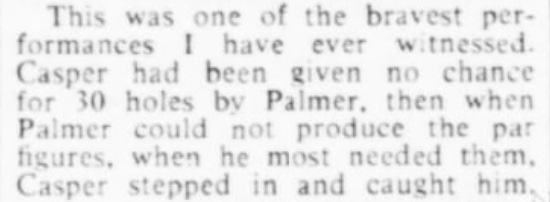
Leonard Crawley of the London Daily Telegraph pointed out the Casper never missed a fairway in the last 12 holes, and was spectacular down the stretch going 2,4,4,4. In fact, Casper never had to write more than a 4 on his scorecard during the back 9, in which he shot a 32. It was the finish of a champion.
Crawley added this:
Art Rosenbaum, of the San Francisco Chronicle, asked Arnie what happened on Sunday:
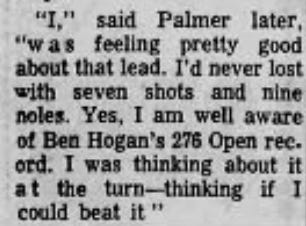
Arnie was being himself, playing aggressive. He didn’t know how to play defensive golf and nurse a big lead down the stretch.
Jim Murray, the witty syndicated columnist from the Los Angeles Times may have summed it up better than anyone else regarding what happened when he wrote, “He plays the game like a guy playing blackjack who gets 19, and says, “hit me again.”
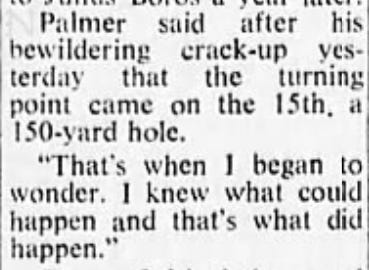
Bill Whittaker of the Sydney Morning Herald, spoke to Palmer about the par 3 15th which saw the 1st of the 2 consecutive 2 shot swings:
Dave Lewis, sports editor of the Long Beach Independent had this take: “Nobody present will deny that Arnold Palmer played some of the most sensational golf through 67 holes as any man in history. He would have breezed home the winner if he “just hadn’t been so bull-headed,” as one fellow pro summed up the situation. Losing the tournament will go down as the biggest blowup ever recorded in a major event.
Closer to Palmer’s hometown of Latrobe, PA, Al Abrams, of the Pittsburgh Post-Gazette made this prescient statement about Palmer’s performance, “They will talk for years to come about the National Open that Arnold Palmer “blew” the past couple of days in San Francisco. Palmer had the crown beautifully wrapped Sunday and ready to be delivered to Latrobe to be placed alongside the hundreds of other trophies he has won. Then his game collapsed.”
Yes, Al you were right. It’s over 60 years later and we’re still talking about the National Open that Arnold Palmer “blew.”
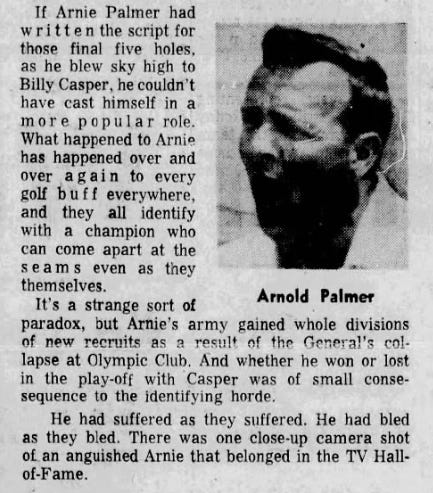
And yet, in “blowing” the U.S. Open, Arnold Palmer may have inadvertently made himself even more popular than ever. At least that is theory put forth by Gene Ward in the San Francisco Chronicle on June 22nd:
FINAL NOTES
Johnny Miller and Ben Hogan
19-year-old Miller finished with a 74 on Sunday, and that was good for an 8th place tie and low amateur.
Miller finished 1 shot ahead of the legendary Ben Hogan, who ended up tied for 12th.
Both men are now automatic qualifiers for the 1967 U.S. Open.
In the Los Angeles Times, Shavenau Glick wrote, “When Hogan trudges up the final hole, he received a rare, standing ovation from the huge crowd ringing the 18th green.”
Glick also noted that Hogan’s,“Tee to green play was perhaps better than anyone else’s in the Open.”
Casper’s Prognostication
At the very end of the ABC broadcast, a humble winner, Billy Casper, predicts that Arnold Palmer will “win the open again I’m sure.”
But Arnie never again won the U.S. Open or even another major tournament.
Amazing recap Len! It was like being there and feeling Arnie's angst as I read.
Great work, as always,
Kevin